There’s a particular sinking feeling that comes with opening a fresh box of leaflets. You’ve paid for 1,000 of them. You pull the first one out, and there it is. A typo in the phone number. Or the logo has come out a strange muddy brown. Or there’s a thin white line down one edge where the design should have run off the page.
Print is unforgiving like that. On a website you can fix a mistake in thirty seconds. Once ink hits paper it’s there for good, and the only fix is paying for the whole lot again.
The good news is that almost every print mistake we see is avoidable. These are the checks we run on every job before it goes anywhere near a printer. Feel free to steal them.
Give it some bleed
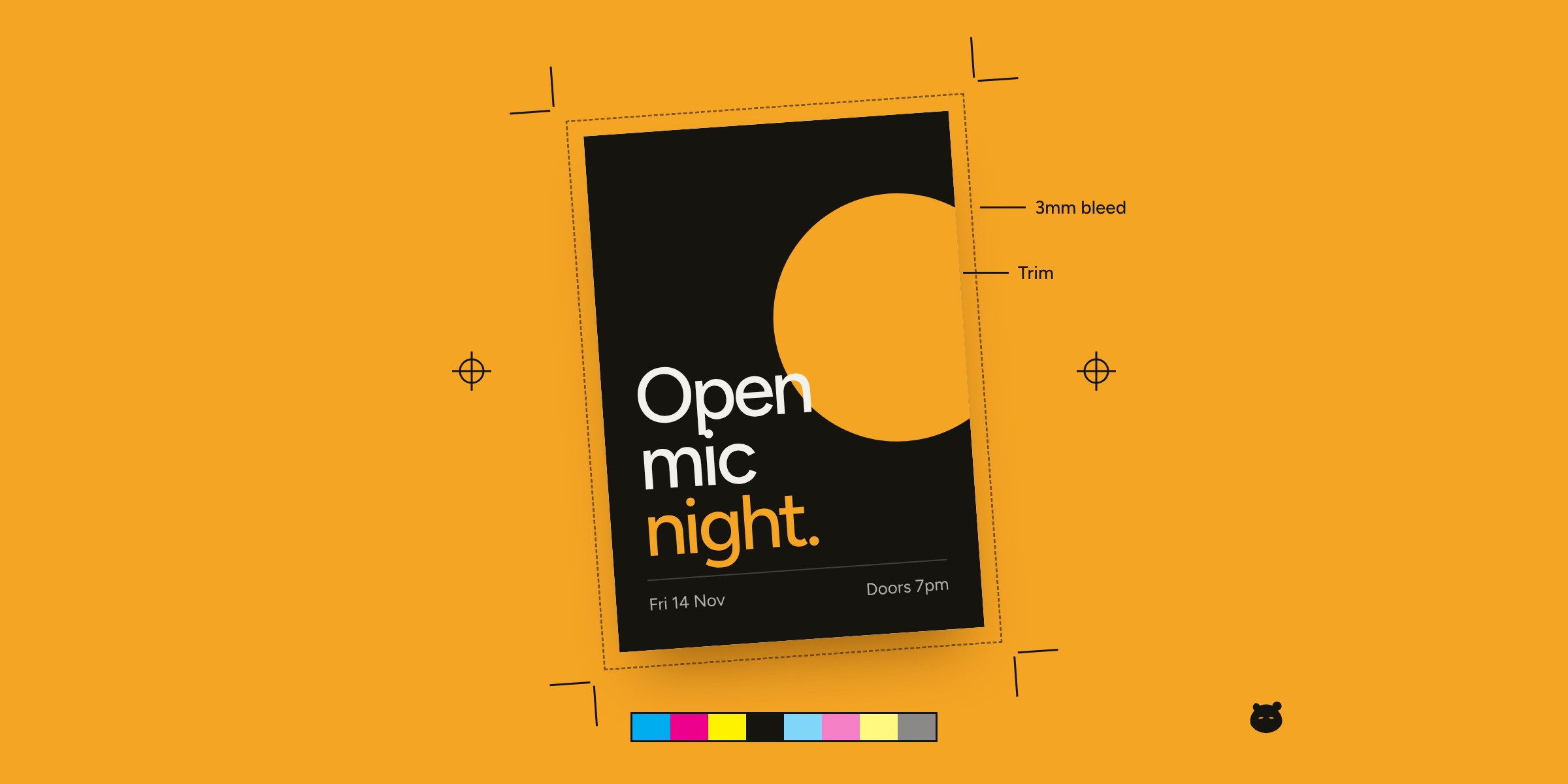
Printers don’t print your leaflet on a leaflet-sized sheet. They print it on a bigger sheet and trim it down. The guillotine is accurate, but not perfectly accurate, and it can drift by a millimetre or so either way.
That’s why anything that runs right to the edge, like a background colour or a photo, needs to extend past it, usually by 3mm on every side. This extra strip is called bleed, and it gets cut off. Without it, a tiny drift in the trim leaves a white sliver along one edge, and that looks cheap.
The opposite applies to your important stuff. Keep text, logos and phone numbers well inside the edge, in what’s called the safe area. We leave at least [X]mm. Anything closer is at risk of getting chopped.
Remember screens and printers see colour differently
Your screen makes colour by shining light. A printer makes colour with four inks: cyan, magenta, yellow and black, known as CMYK. They don’t cover quite the same range.
Some colours that glow on screen, especially bright greens, electric blues and vivid oranges, simply can’t be made with standard ink. Send them to print as they are and they come back flatter and duller than you expected. As a studio whose main brand colour is a bright honey orange, we’ve thought about this more than most.
Make sure your images are print quality
A photo that looks lovely on your phone can come out soft and fuzzy on paper. Screens are forgiving. Print isn’t.
As a rule of thumb, photos need to be 300dpi at the size they’ll actually be printed. In plain English, the bigger it’s printed, the bigger the original file needs to be. A picture pulled from your Facebook page is almost never big enough.
Logos are a separate case. They should be vector files, usually SVG, EPS or PDF. Vectors are made of shapes rather than pixels, so they stay perfectly crisp whether they’re on a business card or the side of a lorry.
Proofread it, then get someone else to
After staring at a design for an hour, your brain stops reading and starts assuming. That’s how typos slip through.
Read every word out loud, slowly. Then hand it to someone who hasn’t seen it before. Pay extra attention to the details people skim past, like phone numbers, email addresses, prices, dates and opening times. A spelling mistake in a heading is embarrassing. A wrong digit in your phone number means customers can’t reach you at all.
Think about the paper
The same design can feel cheap or premium depending on what it’s printed on. People judge with their fingers as much as their eyes.
A business card on thin, flimsy card says something very different to one on a thick, uncoated stock that feels good in the hand. A menu that gets handled all evening needs something sturdy, maybe with a finish that wipes clean. If you’re not sure, ask your printer for a sample pack.
Always see a proof
For anything big, expensive or important, ask for a printed proof before the full run. It might add a day or two, but it’s the only way to see exactly how the colours, paper and finish come together before you’ve committed to the lot.
A proof costs a few pounds. Reprinting 5,000 brochures costs a lot more than that.